

This post is by Jason of World Fitness Network.
I took a trip down to Borders Bookstore the other day and strolled by the magazine section. I’m not usually very thoughtful about these kinds of things, but something really hit me this time.
I looked at the hundreds of publications on display and felt impressed by the number of magazines that were thriving on topics ranging from running, to arts, and even decadent bathrooms.
Who in the world reads a magazine about bathrooms?
Apparently, there is a group of people out there who are passionately interested in reading about bathrooms. Otherwise, this magazine couldn’t profitably sustain itself. Not only does this market exist, but somebody has already learned to profit from it.
But does this epiphany (if you could call it that) about old media mean anything for us new-media types? The answer is yes; it means a lot for us.
Here’s why.
Embracing Disruptive Technologies
In his book, The Innovator’s Dilemma, author Clayton Christensen explains why seemingly great companies often miss the boat and fail to utilize emerging technologies. Their problem is that they listen to their customers.
Yes, a large company listening to its customers can actually be a problem. When a company tries to satisfy its current customer base, the company usually focuses on improving its current product offering. Take the old VCR industry, for example.
Most of us were just happy enough to put a tape in the VCR and see it play. Of course, in order to please more customers, the VCR makers dutifully added more features to improve their product. We got VCRs with a programmable recording function, a complicated remote control, a nice clock on the front, etc.
Of course, none of us really had the time to read the 60-page manual that came with it, so we didn’t set the clocks, and all the VCRs kept blinking “12:00” day after day. In essence, the VCRs had already exceeded the primary needs of mainstream consumers. When a newer technology meets these primary needs in a better way, customers then migrate to the new standard and a paradigm shift occurs. See the illustration below.
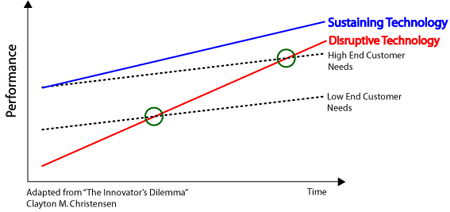
Of course, digital video was quietly making its appearance in the background. Digital video got off to an awkward start with video players that used giant CDs the size of dinner plates.
A few people tried the new format, but some VCR providers were happy to continue improving their own, more-profitable business model. Over time, the digital format was improved, the DVD emerged, and we all know how the rest of the story goes. VCRs are now virtually a thing of the past.
Are Magazines Like the VCR?
A disruptive technology is something that offers a new feature, a cheaper way of doing things, or a more efficient form of delivery. Blogging is to each magazine niche what the DVDs were to analog video. Just as the digital video format slowly replaced VCRs, each niche of old media publications has the potential to be replaced by digital counterparts.
That means that every magazine that you now see on the shelves of a bookstore could potentially translate into a profitable niche for bloggers. Paper magazines likely won’t die completely (at least not right away), but what we’re talking about is the opportunities that new media provides us.
Bloggers may have already begun to make inroads in several niches, but many other niches are just waiting for bloggers to deliver their interests in a more convenient format. Just to give you an idea of the number of niches available, here are some examples of magazine titles that I saw that could represent profitable blogging opportunities:
- Guitar Legends
- Drum!
- HD Video Pro
- Electronic House
- Outdoor Photographer
- American Art Collector
- Ceramics Monthly
- PC Gamer
- Nintendo Power
- DirtRag (Mountain Biking)
- Stock Car Racing
- Golf for Women
- Triathlete
- Recording (For Musicians)
- Jazz Improv
- Skateboarder
- BMX Plus
- Kite Boarding
- Surfer Magazine
- Canoe & Kayak
- Snowboarder
- Men’s Fitness
- Inside Kung Fu
- Field and Stream
- Rifleman
- Leisure Aviation
- Collectible Automobile
- Boating Life
- Quad (ATV’s, 4×4)
- Dogs USA
- Quilt Mania
- Designer Baths
- Elegant Bride
- Nature Garden
- Woodcarving Illustrated
- Bead Style
- Art Doll Quarterly
- Model Railroader
- Linux User
- Web Designer
- Windows Vista
- Photoshop Creative
- Simply Knitting
In the end, every magazine on the shelves of the bookstore represents a potential niche that might be profitably replicated in the blogosphere. A blogger doesn’t necessarily have to reinvent the wheel when it comes to making money, but rather we should learn from the success of old media and apply that knowledge to this newer, more disruptive technology.
By looking at the old media, we can get a great sense for which niches can be profitable and what their associated products are. In those niches, we can often make money in the same way that old media publications do, such as the following:
- Paid subscriptions: We bloggers refer to this as paid membership sites.
- Advertisements: Magazines offer print ads. We might offer banners, text-link ads, etc.
- Direct Product Sales: Magazines do this all the time. A publication might create a complimentary product that may or may not be generic, and then sell it to their audience. Blogs can also leverage affiliate sales, or open an online retail store with related products.
As Brian said before, we simply need to attract 1,000 people who are willing to spend money in a particular field of interest. Your local magazine stand can tell you what those fields of interest are, and also what those people are willing to spend money on.
So, which niche will you be disrupting?
About the Author: Jason is the author of World Fitness Network, a blog that helps you learn how to lift weights, live strong, and stop being such a fatty.

Reader Comments (33)
Copyblogger,
Great post. We thought the exact same thing a couple of years ago when we left the publishing world to focus online. We currently have three sites – VitalBMX, VitalMX, and VitalSkate. These sites represent two categories you mention on the list of potential opportunities.
The quote we often use is, “If Henry Ford would have asked people what they want, they would have said a faster buggy whip.”
Todd
“In the end, every magazine on the shelves of the bookstore represents a potential niche that might be profitably replicated in the blogosphere.”
True enough!
Just be sure to check out the existing online niche of some of those titles before diving right in with a new blog, as some already are being profitably replicated in the blogosphere. There’s dozens upon dozens of knitting and beading blogs, for example, and hundreds of gaming ones.
Though I suppose someone could just read Copyblogger and develop the blogging skills to make the best new blog in any of those niches! ^_~
Offline magaiznes have always been the best way to discover niches since research has obviously been done already, and it’s a sustainable market.
Another disruptive technologoy coming out is one that will allow for downloadable movies, thereby putting many offline video stores out of business.
I think I’m just a disruption by nature. Can I call myself a niche?
Great post, Jason – I’m going to have to think about this one!
great post – this is actually the rationale i used when accepting my current job (online content manager for Log Home Living, Log Home Design and Timber Home Living).
These are extremely strong print brands with loyal audiences. Our challenge is to translate that success to online (in progress…but making great progress) and repackage the content for new audiences.
so far, so good. but it is eye-opening. what other opportunities are out there? my guess? billions.
Don’t forget that Guitar Legends, MOJO and UNCUT do special issues, as well as seasonal printing. This means that in addition to the regular monthly mags, they somtimes print other mags on niche topics or artists, sometimes covering just ONE artist- Hendrix, Beatles, etc.
Cool huh?
I don’t know if they lose money on that or not- probably they break even or profit just on the advertising- and the sales are icing on the cake!
I agree with you about the niches, but examples of paid subscription sites are few and far between, so other revenue streams (the pair you cited, and others) are more likely business builders.
@ #6:
from my experience, the more “niche” those targeted publications are, the more cash they can derive from advertisers. i wish i remember who said it (maybe i just thought of it) but someone once said “the nicher the richer,” for this very reason: a more targeted consumer base.
for instance: you print a magazine on houses, you can sell general ads in the issue to a window manufacturer. but if you do a special issue on windows, the manufacturer is more likely to offer a premium, because he/she knows that whoever picks up the issue, is qualified and specifically interested, with a higher conversion rate.
oftentimes when i think of potential blog concepts, i think too broadly. i’m still waiting for the stroke of genius to…stroke me (sorry for the disturbing imagery).
Nice write, and a nice website, too, Jason.
Buck
A disruptive technology is something that offers a new feature, a cheaper way of doing things, or a more efficient form of delivery.
True, but you’re forgetting that magazines and books have their own MASSIVE advantages over online media too.
You get a physical, collectable product that’s resaleable. You can cut out stuff, loan them to friends, and you get much better pictures than you can get online (important if the niche is a visual one.) A lot of people also like to read their magazines in bed, on the train, wherever, and printed media is a lot “nicer” to read than text from a screen. These are all pretty big deals.
I’m not going to switch my glossy fashion magazines for online equivalents, even if I’d ALSO subscribe to more “disruptive” online versions. Perhaps extending, rather than replacing, should be the focus here.
Looking at “old media” is a good way to discover niches, as you say, but I don’t think disruptive technologies can yet replicate much of the experience in a significant number of areas.
I think I need to read your text more carefully, you seem to be on to something, I am just not sure what.
Peter-
True, magazines do have advantages over online media like the ones you mentioned, such as the ability to read them anywhere and the better images they have.
But I also think that blogs and other technology can continue to improve and be more disruptive to each niche. I already create many of my own images of weight lifting for my own site, and I may someday be able to do professional images of pro bodybuilders like magazines do. As innovation continues, maybe we will read blogs comfortably in bed with iPhone-like devices.
It’s hard to know what things will be like in 10 years, but I agree that magazines won’t be completely disappearing anytime soon. Print media just has certain advantages that some people value, and blogging will only replace magazines for the people in each market who like the cheaper and more frequent delivery… but I personally believe there will be more and more of those people as paradigms shift and as bloggers improve their offerings.
I look at magazines in the supermarket every week for blogging ideas but somehow seeing them listed in print in this post gave me more ideas.
The trouble with looking at magazines in the store is that the pictures on the covers distract, it helps to sell them. Just seeing subjects written in text is much more effective in giving ideas.
I guess that takes away Flickr from me as a way to get ideas for blog posts.
Well written. I was just talking to someone recently who said that blogs are reaching a mature status. Wrong! We’re just at the front end of this and we don’t even know it yet. Very thought provoking post. Thanks.
Excellent and thought-provoking post, Jason.
I’ve been thinking of niches and you’ve got me thinking about more! :o)
I love my mags. I blog about several subjects, but my eyes get tired of staring at the screen after a while. I hope my posts never completely get rid of my magazine competitors.
My goodness. I am so glad to have found this site. I am a realtor with, of course a real estate blog but I also now see the possibilities of doing the same in one of my hobbies. Thanks for the disruption.
What does “disruptive” means in the blogosphere?
Is it something weird, like “The British Bathroom’s Blog” (BBB)?
This is a very inspiring post… thanks a lot!
Hope I can find the way to be disruptive with my blog… specially because it’s written in spanish and there are just a few blogs in my language 🙂
great text, great information, we are at the beginning …!
Thats a great idea. If those niches are profitable on paper , then most probably they should do well on the net as well. Its amazing how much can you learn from the old technologies for a new idea. Thanks for some cool ideas.
There are always like-minded people out there in the nether regions of the net. No matter how obscure or innocuous you will have at least one other individual who shares your particular proclivity. These may, or may not, translate to a sustainable audience base.
A few examples that come to mind:
• Mini-Bottle Ship Builders
• Irish Kilt-Wearing Pinochle Club
• 5 Ft. and Under Plushies
• The Yeti Abduction Survivors Gang
• Polydactylism Clothing Emporium
• Body Brushes for Hypertrichosis
Great article. I took this same approch with my Mortgage business. If a company becomes stagnet; it will die. Use technology and find a niche to serve.
The “Inside Kung Fu” niche is not so profitable–but I call dibs anyway.
Brian – Thanks for the insight on niche marketing. I’m a firm believer in zeroing in on a market rather than using a shotgun trying to speak to everyone.
I am reading your article with a smile as I basically used this same strategy to develop my niche blog for marketing ideas for martial arts school owners. Chris may have dibs on the “inside Kung Fu” niche but I call dibs on martial arts school owners!
Interesting correlation here with the magazines and some of these being so specific. Being a Realtor here in the Santa Barbara area, blogging allows me to let consumers know about my knowledge of the industry and the “inside scoop” that I have. For me blogging is in itself a niche.
The interior design field has many bloggers who post original content and also dissect to the minutest detail the content of each months’ shelter magazine offerings. Often, we’re out ahead of the magazines because we can post immediately and they have a several month product cycle.
I actually got my first ideas of a blog niche from offline magazines. After reading this post, I have rekindled those ideas and now I can find a steady source of ideas. Great post! Thanks!
I think I need to read your text more carefully, you seem to be on to something, I am just not sure what.
This is very interesting and a great starting point for me to understand how to best maximum income from my blog. I will be coming to to read more regularly
This article's comments are closed.